
by Melinda Palacio
by Carrie Vaughn
The lungs are not two large balloons.
Spongy bronchus branches stretch down and
hold clustered pockets of air like fruit hidden
in our core, flavored with each inhale whether
mountain or wildfire or assassin. Each breath is
an exchange. Out. In. Useless for useful. A bargain
struck in collective exhale by earth’s first life. A deal
fragile as any tree in a harvester’s blades. Tenuous
as a trachea. Infection grew my mom’s lungs darker
daily, until they were only shadows, her pink and
flexing organs swapped for construction paper
cutouts barely twitching in the wind.
The left lung is somewhat smaller than the right.
Space must be made for the heart.
______________________________________________________________________
Carrie Vaughn is a poet and middle school science teacher. She received her MFA in poetry from Oregon State University. She currently lives in Baltimore, MD with her partner and their musclebeast mutt. Her work has been published in Entropy and Grist.
by Ada Limón
by Vivian Eyre
The wall photograph—taken right there—
a girl, lying on your stomach, face almost touching
the tidal pond. Looking for what? Water fleas,
red-plumed tube worms,
the widening rings of being.
How much time to see—
as much time as it takes to make a friend—
cunners & hat pin urchins,
snails & gills, rock grit & us.
I’ve read about Aristotle & limpets,
how a muscled foot locomotes
into the sea to feed. How a limpet’s shell
imprints like a scar/tattoo on the home-rock.
And the limpet always returns to the same spot.
Aristotle never figured out how
this homing works.
A home can be a room in an inn,
beyond the deep & wide, Sheepscot,
sun-dried rocks, glistening.
______________________________________________________________________
Vivian Eyre is a Rhode Island-based poet, and the author of the poetry chapbook, To the Sound (Finishing Line Press). Her poems have appeared in literary journals such as The Massachusetts Review, The Fourth River, Moon City Review, and elsewhere. She served as a rescue volunteer for marine life on Long Island.
by Lara Hamidi-Ismert
Fridays I drive west on Quincy—
a fox avoiding its foxhole—
to the wheat fields, away from
someone else’s bed, the sweet
mildew of beer-rotting floors.
I lie on my back in the weeds,
itchy, cold, alone, and let only
the stalks graze me. Out here
the obtrusive city light is hushed
by the dark. I see meteors streak
the sky far more often than my
mother ever confessed they do,
and she never warned of the cry
a mountain lion makes when
it’s crouched low in the grasses
of southeastern Kansas, like
a baby left on a gravel road—
confused, hungry, beckoning.
______________________________________________________________________
Lara Hamidi-Ismert is an Assistant Professor of Mathematics at Embry-Riddle Aeronautical University in Prescott, Arizona. Her poetry appears in Caustic Frolic, Feral: A Journal of Poetry and Art, and Tether's End Magazine. She has also published articles on the mathematics related to quantum mechanics in Communications in Mathematical Physics and New York Journal of Math. Lara earned a PhD in mathematics from the University of Nebraska after earning a BA in creative writing and a BS in mathematics from Pittsburg State University in Kansas. When she’s not mathing, she writes poetry and short fiction, acts in theatre productions, hikes with her husband, and scoops her four cats’ litter boxes.
by Maw Shein Win
My ovary, an egg desert.
Fortnight Lily, petal armor.
Uterus, container of blood memory.
Left ovary, a mourning bud.
Swallow painkillers, lean back in tub.
One perfumed fibroid, rock melon.
Remove seed pods from cervix. Bouquet effect.
Floating frond, an enigma in the canal.
Disorderly array of tissues, tendrils.
Blooms in dark.
______________________________________________________________________
Maw Shein Win’s poetry collection, Invisible Gifts: Poems, was published by Manic D Press (2018). Win is the first poet laureate of El Cerrito, California. Her poetry collection, Storage Unit for the Spirit House (Omnidawn, 2020), was longlisted for the PEN America Open Book Award and a Northern California Book Award for Poetry, and shortlisted for the California Independent Booksellers Alliance’s Golden Poppy Award. She often collaborates with visual artists, musicians, and other writers. See mawsheinwin.com
by Charlotte Foreman
when you were born / in a passive red sluice
some hot providence asked the palms to move
Heaven’s ferns peeled back / to give you an orange
from the groves of Orlando / light flooded the tidal
marshes / in a place south-er than south / afternoon
sun presses through Spanish moss / I don heels
from Kohl’s / a baby blue dress / become a woman
in the community center / all these lives around me
______________________________________________________________________
Charlotte Foreman is a writer and educator in Davie, Florida. She received her B.A. in Written Arts from Bard College in 2020. She is the English editor-in-chief of the international cultural criticism magazine The Swings and is currently completing a 200-hour yoga instructor training. Her work has previously been included in Yew! Magazine and Waterproof: Evidence of a Miami Worth Remembering, published by Jai Alai Books.
by Chloe Martinez
It's #tbt! Enjoy this great one from SWWIM Every Day's archives!
______________________________________________________________________
A wave slides slantways under surfers, skinny teenage
hips kicked out as they fall in water
that swirls like mercury, and the kids
shrieking in the shallows, and the tankers
still as the corpses of giants along the horizon line,
and the pier rough-tumbling out to its conclusion.
Small boys: kick water at one other.
Old people: sit on the bench. Observe.
Skinny girls: selfie, selfie, text. My baby,
not a baby anymore, tugs my shirt aside anyway, nurses.
The surfers falling and falling. The first-grader’s current
joke: Why do seagulls fly over the sea? Because,
if they flew over the bay they’d be bagels!
Bend the knees, bend the knees,
swivel-twist, fall back, fall back, fall.
A teen with boy-band bleached hair
smokes beneath the pier. You’ve been at sea
for some time now. You’ve been
sick of it. But then, the roar of the waves
calms you too. The kids are doing handstands
at the waterline like your inverted
brain, sand-suck around their hands
as the tide runs out, the world
upside-down, then slowly righting itself.
______________________________________________________________________
Chloe Martinez is a poet and scholar of South Asian religions. She is the author of the collection Ten Thousand Selves (The Word Works, 2021) and the chapbook Corner Shrine (Backbone Press, 2020). Her work has appeared in AGNI, Ploughshares, POETRY, Prairie Schooner, TriQuarterly, Shenandoah, and elsewhere. She works at Claremont McKenna College and lives in Claremont, CA with her husband and two daughters. See chloeAVmartinez.com.
by Julia B. Levine
and stand on the balcony, listening to deer
step through the crisp of dead leaves.
Behind me, the dream.
Your body asleep in our bed. Above me,
a river of half-living, half-dying stars,
Now the stony knock of a falling acorn.
Now my knot of terror at losing you.
Once we hiked into these hills
to a ruined homestead. Moss and vine
and bramble. House as rumor,
a few fitted stones, a fallen beam.
It was late afternoon. Red on the gold hills,
sound of a river we searched to find,
but it was just a breeze
moving between leaves.
I remember we undressed
and lay down
inside the hieroglyphics of shelter
that meant finally nothing
could hold us, your breath
on my neck, our bodies binding,
unbinding in sunlight.
______________________________________________________________________
Julia B. Levine’s many awards for her work include the Northern California Book Award in Poetry for Small Disasters Seen in Sunlight (LSU press, 2014), the Pablo Neruda Prize in Poetry, and the Bellevue Literary Review Poetry Prize. She has been published widely in anthologies and journals, including The Southern Review, Ploughshares, Prairie Schooner, and The Nation. Her fifth collection, Ordinary Psalms (LSU Press) was published in 2021. She lives in Davis, California, where she serves as the current poet laureate.
by Raina J. León
above us there are no helicopters
not like when the wind
smelled like california soot
and every hour sirens wove
their hair into ours and sung
names to enchant cacophony
say their names and we were home
your sister newborn in my arms
protecting her life a protest
weeks before, each time a plane
scored the berkeley sky in white
you would point up
say mamma because i am always
in the sky even when my skin
burns in the sun next to yours
how my eyes leak with storms
you cannot yet name
we stand in unhinged weather
there are no helicopters today
you bang on a wheelbarrow
with dried bamboo stalks as drum sticks
and lift your toddler throat up to shout
‘cotto! over and over again
a screamo chorus
lyrics perfectly formed to your ears
i nod only yes
and keep beat
at the people’s park
marchers assemble
with banners of i can’t breathe
san pablo, i can hear
the horns of a car parade
inside the mourners shout behind masks
from open windows
while a virus flies around us all
pandemic in crown
and white
surrounded by fences
i can keep you safe
and breathing
until i can’t
every door has the threat of splinter
there are no helicopters today
‘cotto you yell
somewhere they descend
somewhere a body hangs
halfway between metal and earth
______________________________________________________________________
Raina J. León, PhD is Black, Afro-Boricua, and from Philadelphia. She is the author of Canticle of Idols, Boogeyman Dawn, sombra : (dis)locate and the chapbooks profeta without refuge and Areyto to Atabey: Essays on the Mother(ing) Self. She has received fellowships and residencies with Cave Canem, The Obsidian Foundation, and Vermont Studio Center, among others. She is a member of the SF Writers Grotto and the Carolina African American Writers Collective. She also is a founding editor of The Acentos Review, an online quarterly, international journal devoted to the promotion and publication of Latinx arts, which has published over 900 Latinx voices in its history. She is an emerging visual artist and digital archivist, particularly with StoryJoy, which she co-founded with her mother, Dr. Norma Thomas. She is the lead coordinator for Nomadic Press in Philadelphia and a senior researcher and editor on various grants in education and literature. Find her on all the platforms @rainaleon.
by Kiyoko Reidy
Stinging nettle mashed or dried, dandelion
leaves with their bitter milk—steep in tea,
add to salad, or prayer. In the waiting room,
all the women are pregnant, and I am
jealous. One moth clings to a lit
bulb, its feet burning with light,
tiny brain firing off with pleasure.
The prefix mis— originally meant
to change; now: ill, wrong, absence,
negation. As though change flows only
downstream, the direction of loss. My mother
describes field dressing a deer in detail: winding
through thick cords of intestine
like combing a daughter’s hair. The snow
dotted with birds, dark bodies against the white,
While my organs flash like abstract art
on the screen someone leans into the sky at the apex
of the world’s tallest building seventy-five
hundred miles away. Still, someone builds toward
heaven, as though they’ve learned
nothing. Still, we risk it—proliferation
of language, the collapse into confusion.
The technician with her mouth ajar
asking when I’ll meet with the doctor.
The other nurse in the room looking
worried, or just exhausted. Only one man died
building the Burj Khalifa—If we had known
in advance, the building would have been
built anyway. To call something an attempt
is to admit failure. In front of me, the uterus. A dark bean
on the ultrasound, set in the body’s center and cut
through by a crease of light—my vanishing point.
______________________________________________________________________
Kiyoko Reidy is a poet from East Tennessee. She currently lives in Nashville with her partner and two dogs. Her poetry and nonfiction is published or forthcoming in the Cincinnati Review, RHINO, Sugar House Review, Missouri Review’s poem of the week, Creative Nonfiction’s Sunday Short Reads, and elsewhere.
by Elizabeth Sylvia
After watching the documentary Free Solo
I keep thinking of you measuring the walls,
saying you’re allowed one question every day
about furnishing the condo Alex has just bought,
or when you asked him in the front seat of his van
(saying you’re allowed one question every day)
if you were someone worth not dying for
or, when you asked him in the front seat of his van
to rate his happiness, how blank he looked.
If you were someone worth not dying for
you would be someone more than just a girl
to rate his happiness. How blank he looked
remitting your devotion and your hope.
You would be someone more than just a girl
if you were loved by someone far out on the ledge,
remitting your devotion and your hope
with the reflective glow of his cold greatness.
If you were loved by someone far out on the ledge,
his hands would always hope for stone
with the reflective glow of his own greatness
before him on the mountain face.
Alex’s hands will always hope for stone,
the form that excellence must take for him;
before him on the mountain face
your passions can’t seem anything but trivial.
The form that excellence must take for him
makes people on the ground seem tiny specks,
our passions can’t seem anything but trivial.
Heights and solitude like that
make people on the ground seem tiny specks.
Don’t come to see yourself
from heights and solitude like that
as if your soul were no more than a dot.
Don’t come to see yourself
as little. Things you love
as if your soul were no more than a dot
are great things even in their commonness.
As little things we love
are requited, they become
great things, even in their commonness:
Those joys and cares tie us together.
Requited, they become
the solid rock to build a life upon,
those joys and cares that tie us together,
shared work, shared devotion.
The solid rock to build a life upon
isn’t furnishing the condo Alex has just bought,
but shared work, shared devotion.
I keep thinking of you measuring the wall.
______________________________________________________________________
Elizabeth Sylvia (she/her) is a writer of poems and other lists who lives with her family in Massachusetts, where she teaches high school English and coaches debate. Elizabeth’s work is upcoming or has recently appeared in Salamander, Pleiades, Soundings East, J Journal, RHINO, Main Street Rag, and a bunch of other wonderful journals. She is currently working on a verse investigation of the writer Elizabeth Barstow Stoddard.
by Beth Gordon
It's #tbt! Enjoy this great one from SWWIM Every Day's archives!
______________________________________________________________________
There is no mortician or used car dealer in the town
where they tested the bomb. No place to bury bodies
without disturbing nuclear dust, Oppenheimer dead
from multiple cellular mutations. We move out of desert
towards hurricane memories and seashell swamps and she
tells me about the acres of land she will buy, the horses
she will count and name. We have nothing in common
but funerals and highways and she searches for cigarettes.
I wonder if I am wrong to be suspicious of grapes grown
in sand fertilized by heron hatchlings. Pirate’s gold. Purple
wildflowers shaded by Spanish moss. Azaleas and palm trees
search for April sunshine and billboards appear like haunted
ships in fog. Breast enhancements, injury law hotline, gun show
at the state fairgrounds. I suggest Clementine, Madeline,
Layla, knowing that she hasn’t slept more than three hours
at a time for the last four years. O Lord Make a Shepherd
of Me in this land of bone dice and my stepmother’s suicide.
I want to swallow salt and fiddler crabs, but I taste panther
and pig, the lovely buzzing of low flying planes. The wildfire
daydreams of insomniacs and horses and unexpected cows.
______________________________________________________________________
Beth Gordon is a poet, mother, and grandmother currently living in Asheville, NC. She is the author of Morning Walk with Dead Possum, Breakfast and Parallel Universe (2019, Animal Heart Press); Particularly Dangerous Situation (2020, Clare Songbirds Publishing);This Small Machine of Prayer (2021, Kelsay Books); and The Water Cycle (2022, Variant Literature). Beth is Managing Editor of Feral: A Journal of Poetry and Art; Assistant Editor of Animal Heart Press; and Grandma of Femme Salve Books. Twitter and Instagram @bethgordonpoet.
by Jocelyn Ulevicus
When a woman from my sober group
confessed to me that she felt invisible,
I did and didn’t feel that—the tension of
aging out of the civil hold society still has
on its women. The burning question is not,
should I drink, but how do I stay relevant
as my body changes, without having given
birth or given away my name and even still,
to be known is the ultimate disobedience—sitting
with my two breasts out, carving space in the
remembered world. I wanted more for my own
mother, even if that meant not having given
birth to me. That’s what I think of when I see
a particular wedding image of her pitched on
a small green hill, carving space against a stark
blue sky, her veil caught in the wind as if to
say it knew something none of us did.
______________________________________________________________________
Jocelyn Ulevicus is an artist and writer with work forthcoming or published in magazines such as The Free State Review, The Petigru Review, Blue Mesa Review, No Contact Mag, Blue Bottle Journal, The Santa Ana Review, Humana Obscura, Dewdrop, and elsewhere. Working from a female speculative perspective, themes of nature and the unseen; and exit and entry are dominantly present in her work. She resides in Amsterdam and is currently working on her first book of poems. You can contact her on Instagram at @jocelyn.ulevicus or via her website: jocelynulevicus.com.
by Shir Lovett-Graff
The week I binge an anime show / is the same week I practice a tahara [1] / in the first episode / they lose arms and legs / and bodies / deconstruct and reconstruct / from metal, skin and souls / they call it / transmutation / they transmute their limbs / deconstruct themselves / and reconstruct their hands / to practice again / the only rule / they can’t bring back the dead / in my first tahara ritual / I wash her body / a grandmother / comb her tangled hair / keep her head steady / a precious vase / full and empty / it made me question / the softness of my mother / her swollen lungs / my own body / existing / however long / we transmute this grandmother / into gentle rest / sprinkle dirt / like snow / upon her linens / pray to collect / her beauty / upon returning home / I watch the second episode / learn about creatures made of souls / and memories / from people who died / aren’t we also souls / and memories / from people who died / don’t we also transmute / each touch / a renewal / each glance / a blooming /
[1] Tahara, meaning “purity,” is a Jewish ritual cleansing of the deceased, often performed by members of a local Chevra Kadisha, meaning “holy society.”
______________________________________________________________________
Shir Lovett-Graff is a writer, organizer, and student at Harvard Divinity School studying conflict transformation and spiritual care. Their creative work has been published in Silver Rose Magazine, EcoTheo Review, West Trestle Review, SWWIM Every Day, Poetry Online, and more.
by Beth Oast Williams
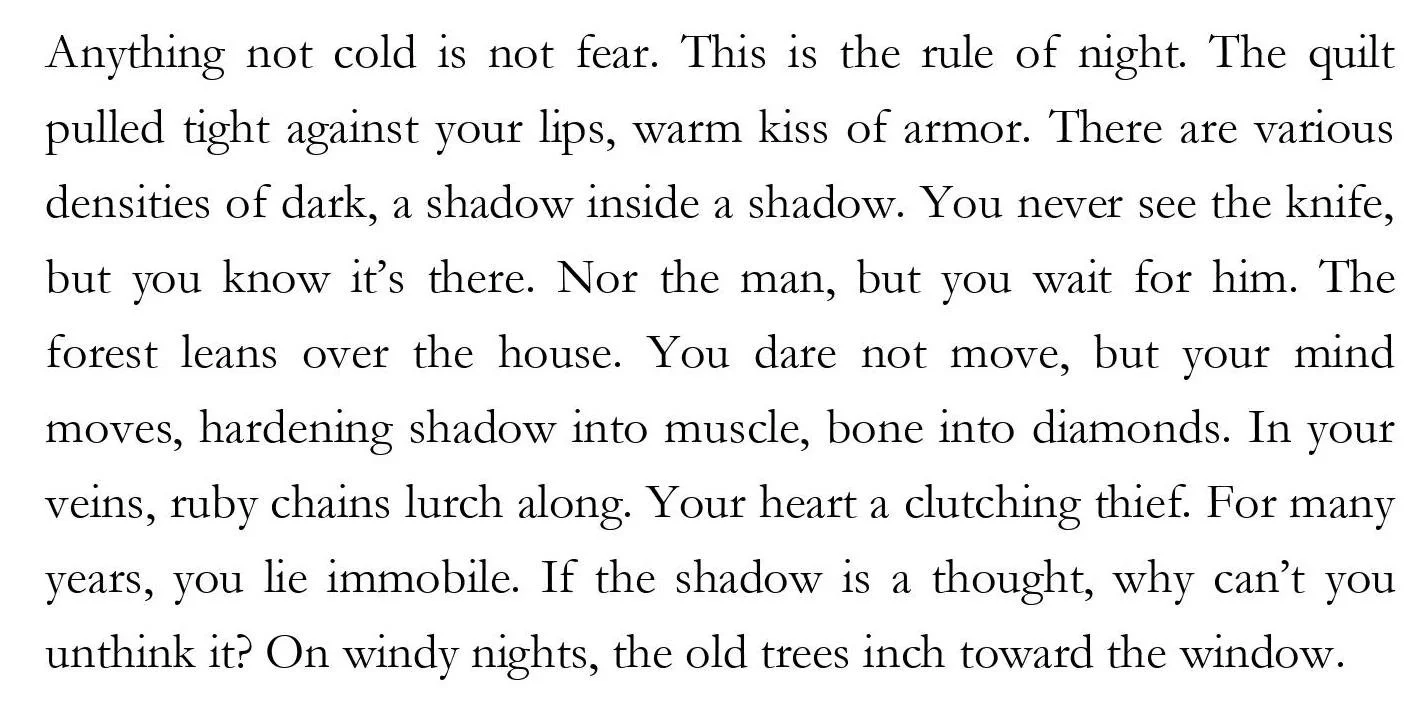
Dark Matter
by Cynthia Marie Hoffman
by Rebecca Aronson
It's #tbt! Enjoy this great one from SWWIM Every Day's archives!
I used to hip-check the jukebox
when I passed it if I didn’t like the song playing;
the music would veer and skip where my curve met
the rounded corner of neon and metal. I took out Peggy Lee’s guttural whine
this way every month until they finally stopped replacing it.
I looked good in my stain-hiding brown waitress uniform,
all camber and coil, shined up with kitchen heat
and magnetic. Who wants to be reminded
magic is illusory when the dove is still flying
out of the hat with such disarming reliability?
I wanted to dance because dancing made a flame
lick at the edges of everything. Here was the secret
to living: what is dull can be polished
to a hot glow with the right friction.
What is lost can be added to the heart’s altar.
Peggy Lee wailed her faith in disappointment
but she was wrong:
even the fryer grease
which hung in the air and followed me
from work to the bar after
once made a hungry boy tell me
I smelled miraculous.
______________________________________________________________________
Rebecca Aronson is the author of Anchor, forthcoming from Orison Books in October, 2022; Ghost Child of the Atalanta Bloom, winner of the 2016 Orison Books poetry prize and winner of the 2019 Margaret Randall Book Award from the Albuquerque Museum Foundation; and Creature, Creature, winner of the Main-Traveled Roads Poetry Prize (2007). She has been a recipient of a Prairie Schooner Strousse Award, the Loft’s Speakeasy Poetry Prize, and a Tennessee Williams Scholarship to Sewanee. She is co-founder and host of Bad Mouth, a series of words and music. Her website is rebeccaaronsonpoetry.com.
by Nicole Tallman
I’m like a birch tree in the naked white of winter.
The birch that autocorrect first changed to bitch then butch.
I’m shedding layers of black and white paper and ash.
Newspapers have never been more alive or dead,
as I silence my phone and turn to
phonographs, still photography, and vinyl.
Here I find comfort,
among the old, the dusty, the musty, and familiar—the 1880s
and the 1980s
the granny panties and overwhelming old French perfumes.
Here I crank up the heady rose,
the saccharine violet, the languid linden blossom,
resurrect the pink fluorescent
of my faded electric youth.
______________________________________________________________________
Nicole Tallman is the Poetry Ambassador for Miami-Dade County, Associate Editor for South Florida Poetry Journal, and Interviews Editor for The Blue Mountain Review. She is the author of the hybrid prose-poetry chapbook Something Kindred (The Southern Collective Experience Press), and her debut full-length book is forthcoming in the summer. Find her on Twitter and Instagram @natallman and at nicoletallman.com.
by Violeta Garcia-Mendoza